

_edited.png)
What Is the Downfall of Spray Foam Insulation?
- 20 hours ago
- 6 min read
Spray foam insulation gets a lot of attention, and for good reason. It offers strong thermal performance, excellent air sealing, and in some cases moisture resistance all in one application. For many Ottawa homeowners, it can solve comfort problems that traditional insulation products never quite fix. But like any building product, it has drawbacks, and it is worth understanding those before deciding whether it is the right fit for your home.
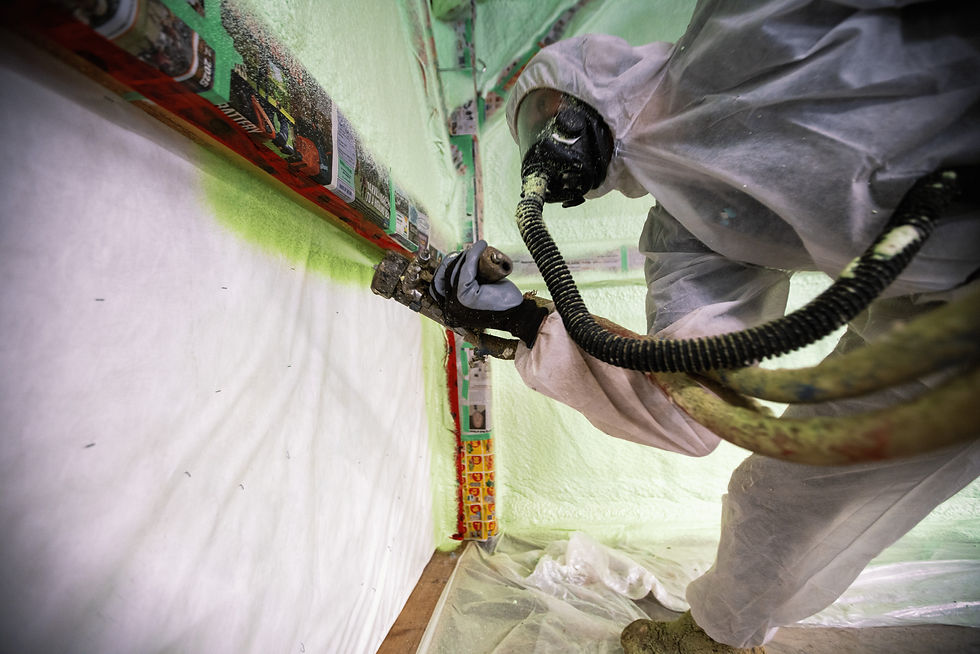
The Price Shock
Let’s start with the one most homeowners notice right away: price.
Compared with fiberglass batts or a standard blown-in attic top-up, spray foam is almost always the more expensive option up front. That higher price comes from the material itself, the specialized equipment needed to apply it, and the training required to install it properly. For homeowners working within a tight renovation budget, that cost can be a real barrier, especially if several parts of the home need attention at once.
That said, price is only one part of the picture. Closed-cell spray foam, for example, can provide insulation, air sealing, and vapour resistance in one system when installed correctly. In areas like basement walls or rim joists, that can make the overall assembly simpler and more effective than combining several separate materials. So, while the upfront cost is higher, the long-term value can still be strong in the right application.
Why Spray Foam Install Matters So Much
The next drawback is one people do not always think about until after the job is done.
Spray foam is very dependent on installation quality. This is not a forgiving product. If the materials are not mixed properly, if the surface is too cold or damp, or if the installer sprays under poor site conditions, the results can be disappointing. Homeowners may see foam pulling away from framing, uneven thickness, poor adhesion, odours, or areas that simply do not perform the way they should.
In other words, spray foam is not a product where “good enough” installation will do. It needs to be done correctly from the start. That is also why it is not a realistic DIY product for most homeowners. Proper installation depends on more than just equipment. It also requires understanding how insulation interacts with vapour barriers, air barriers, ignition barriers, and finishing materials. Ontario-focused guidance for basement insulation continues to emphasize vapour control, air barrier continuity, and full-height insulation coverage in standard compliant wall assemblies.
Moisture Changes the Conversation
Here is where spray foam can get misunderstood.
Spray foam does not create leaks, but it can hide or trap an existing moisture problem if one is already there. If a basement wall, roof assembly, or wall cavity has uncontrolled water entry before the insulation goes in, the issue can become harder to spot later. In Ottawa, spring thaw, wind-driven rain, and older foundation walls can all create hidden moisture conditions that are easy to miss at first.
If those conditions are not found before installation, the result can be mold, material deterioration, or expensive rework later on. That is one reason a good contractor spends time inspecting the area before recommending any product. In many homes, the real issue is not just insulation. It is moisture control first, insulation second.
Is Spray Foam Right for Every Job?
This is one of the most important points in the whole conversation.
Spray foam is not ideal for every assembly. Some roof and wall systems need to dry inward or outward. Some spaces are better served by a more vapour-open insulation product. Some areas may require special fire-protection layers or detailing that make spray foam less practical. Common Ontario code-focused references point to attic levels around R-60, exterior walls around R-22, and basement walls around R-20 in standard climate-zone packages, but those targets do not automatically mean spray foam is the only or best way to get there.
Sometimes blown-in insulation, rigid board, batt insulation, or a hybrid approach is the smarter choice. A good contractor should be able to explain not just where spray foam works well, but also where another product makes more sense.
Plan for Future Access
This is not always a deal-breaker, but it is something homeowners should know before moving ahead.
Access for future renovations can be more complicated with spray foam, especially closed-cell. Because it bonds tightly to surfaces and cures into a rigid material, removing it later can be labour intensive. If an electrician or plumber needs to open a wall or ceiling years down the road, that repair can be messier than working around batt insulation.
For most homeowners, this is simply a planning issue rather than a reason to avoid spray foam completely. Still, it is helpful to know that once it is installed, it is not as easy to move around or remove as more traditional materials.
Temporary Disruption
Another downside is not about performance at all. It is about the installation process itself.
Homeowners should expect some inconvenience while spray foam is being applied and curing. Professional crews follow safety procedures and ventilation requirements, but occupants may still need to stay out of the work area or even leave the home temporarily, depending on the size of the job and the product being used. Once the foam cures properly, it is stable, but the application stage does require planning and a bit of patience.
This is especially worth keeping in mind for larger projects, occupied homes, or renovations where several trades are working on a tight timeline.
What Homeowners Expect vs. Reality
This is probably the most overlooked drawback of all.
Some homeowners hear “spray foam” and assume it will solve every comfort issue in the house. In reality, insulation is only one part of the building envelope. If a home has poor windows, weak attic ventilation, water intrusion, disconnected ductwork, or major air leaks in areas that are not being addressed, spray foam alone may not fix everything.
That is especially true in older Ottawa homes, where comfort problems usually come from a combination of issues rather than one single weak spot. A basement may benefit from spray foam for comfort and moisture control, while the attic may benefit more from air sealing and a blown-in top-up to move closer to current R-60 expectations. Homeowners usually get better long-term results when they treat insulation as part of a bigger strategy rather than a one-product fix.
Final Thoughts
So, what is the real downfall of spray foam insulation?
It is not that the product is bad. It is that spray foam is expensive, technically demanding, and unforgiving if used in the wrong place or installed poorly. Those downsides are manageable when the job is designed properly, but they are still worth taking seriously.
For Ottawa-area homeowners, the most practical way to look at spray foam is this: it is one of the best insulation tools available, but it works best when a contractor is honest about where it should be used and where it should not. If your home needs better comfort, air sealing, or basement moisture protection, Spray-Tech Insulation can walk you through the pros and cons in plain language.
Contact Spray-Tech Insulation to book a free estimate and get an honest recommendation based on your home, not just the product.
Frequently Asked Questions
What are the biggest downsides of spray foam insulation?
A: The main downsides are high upfront cost, sensitivity to installation quality, the potential to mask existing moisture problems, and reduced wall access for future renovations. These are manageable with proper planning but worth understanding before committing to a project.
What happens if spray foam insulation is installed incorrectly?
A: Poor installation can cause foam to pull away from framing, create uneven thickness, produce lingering odours, and deliver inadequate thermal performance. It can also create hidden moisture problems if the assembly was not designed properly. That is why spray foam requires experienced, certified installers.
Is spray foam insulation a bad idea?
A: No — Spray foam is one of the highest-performing insulation systems available when used in the right location and installed correctly. Problems arise when it is used in the wrong application or by an undertrained crew.
Can spray foam insulation cause mold?
A: Spray foam itself does not cause mold. However, if it is installed over an area with active moisture issues, it can trap those problems and make them harder to detect and repair later. That is why moisture conditions must be resolved before any insulation is applied.
Why is spray foam insulation so expensive?
A: The cost reflects the specialized materials, equipment, and certified labour required to install it properly. Unlike fiberglass batts, spray foam cannot be installed as a DIY project — it requires precise mixing, controlled conditions, and trained applicators. That said, because it can combine insulation, air sealing, and moisture resistance in one product, the total system cost may be more competitive than it first appears.
Contact Spray-Tech Insulation to book a free estimate and get an honest recommendation based on your home, not just the product.


Comments